
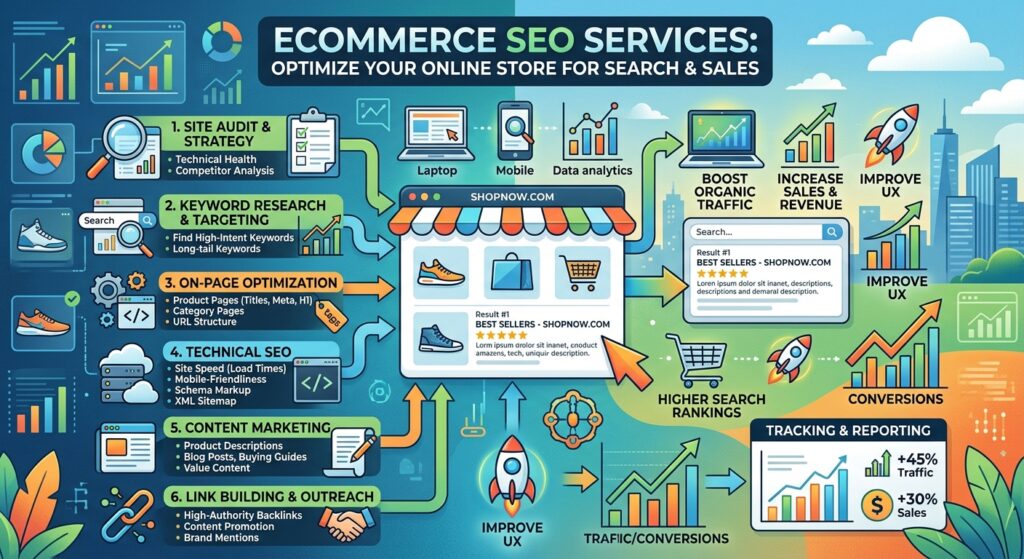
Ecommerce SEO is the process of optimizing an online store’s product pages, category pages, and technical foundation so it ranks for commercial, ready to buy searches. It differs from standard SEO because large catalogs create problems blogs and service sites never face: duplicate product descriptions, faceted navigation that can generate millions of near identical filter URLs, and product variants that confuse both crawlers and shoppers. A strong ecommerce SEO program fixes the technical foundation first, then builds the product data, content, and links that convert search traffic into revenue.
A blog doesn’t have 10,000 SKUs, size and color variants, or a filter for every combination of price and material. Ecommerce SEO exists because of these three challenges.
Every filter combination, size, color, price range, can generate its own URL. Left unmanaged, this wastes crawl budget on near duplicate pages instead of the ones that convert.
Manufacturer descriptions get copy-pasted across hundreds of competing stores. Google can't tell your product page apart from the next one unless the content is genuinely unique.
Fixing one product page is easy. Fixing the template that thousands of product pages inherit, at once, without breaking the ones already ranking, is the actual job.
A full review of your Google Business Profile, citations, on-page content, and competitor positioning, so we know exactly where the opportunities are before we touch anything.
Unique product descriptions instead of manufacturer copy, optimized titles and images, and the structured data that unlocks rich results.
Genuine, unique category descriptions and structure, not just a product grid, so category pages rank instead of relying on paid traffic alone.
Canonical tags, robots rules, and parameter handling that stop filter combinations from burning crawl budget on pages that should never be indexed.
Site speed, mobile-first indexing, and clean URL architecture across the whole catalog, along with a deliberate redirect strategy for discontinued products.
Backlinks from locally and industry relevant sites that build the kind of authority Google's local algorithm rewards.
Supporting content that captures earlier stage searches and links back into your category and product pages, building authority around what you sell.
A link structure that helps search engines and shoppers move from category to product to checkout, without orphaning pages deep in the catalog.
Monthly reporting on organic traffic, rankings, and revenue by product and category, so you always know what's driving sales.
We review your Google Business Profile, citations, reviews, and on-page signals against your local competitors.
Every Seonfix engagement, local included, runs on the same audit-first, transparent-reporting standard.
Four fields. We reply with the audit, not a calendar link.
The budget field helps us tell you honestly whether we are the right fit before either of us spends time on a call. We do not share your details with anyone.
Ecommerce SEO is the process of optimizing an online store’s product pages, category pages, and technical foundation so it ranks for commercial, ready to buy search terms and drives organic sales rather than relying only on paid ads.
Regular SEO usually deals with a handful of pages. Ecommerce SEO deals with catalogs that can run into the thousands of SKUs, along with duplicate content and faceted navigation problems that simply don’t exist on a content-only site.
No credit card. No commitment. Just a real audit.